Ryanair Q1 FY27 Results: Short-Term Pressure, Long-Term Competitive Advantage Remains
Ryanair’s Q1 FY27 results show short-term pressure from lower fares and higher costs, but the company’s low-cost advantage, strong balance sheet and market share potential keep the long-term investment case intact.
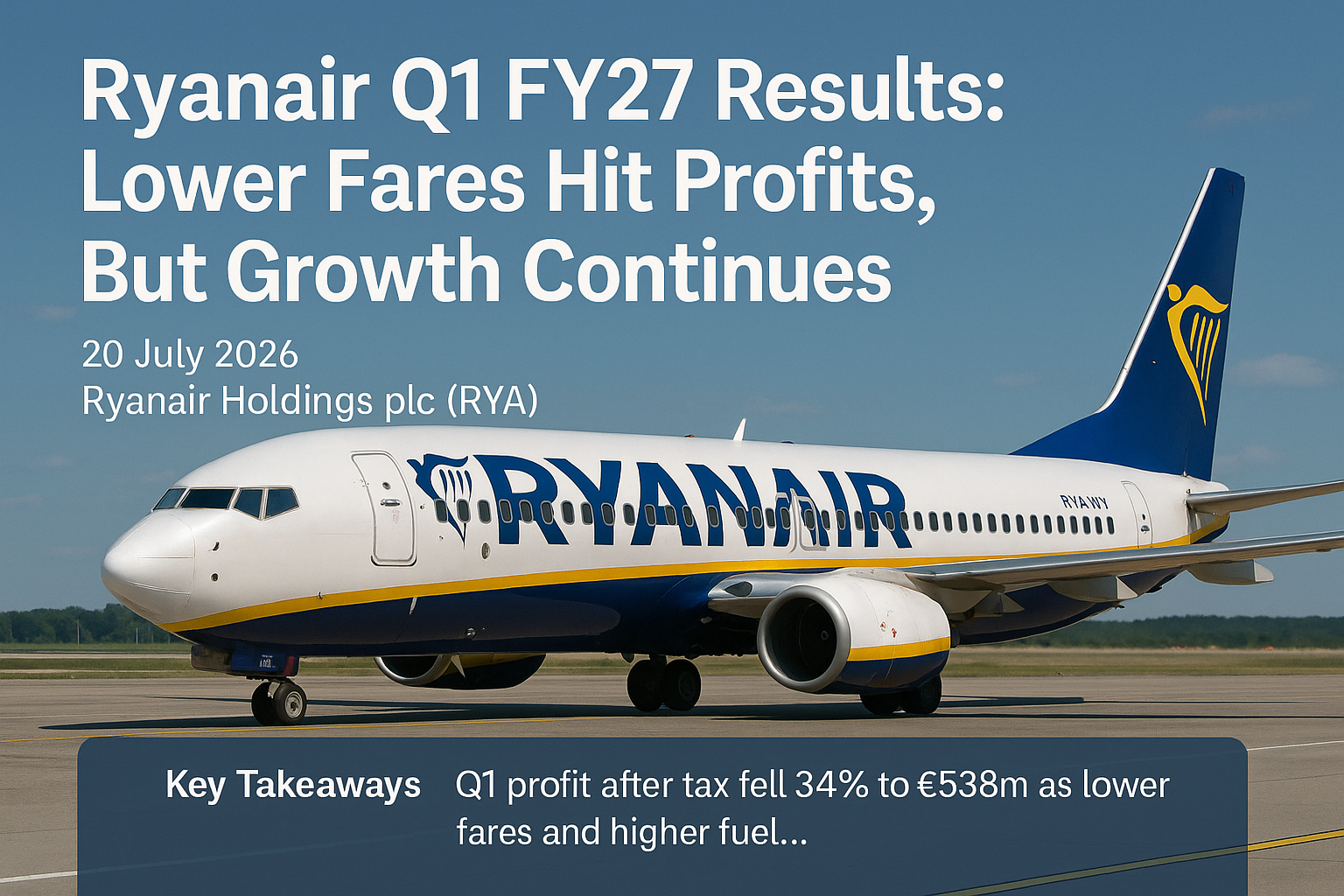
Ryanair Q1 FY27 Results: Short-Term Pressure, Long-Term Competitive Advantage Remains
Company: Ryanair Holdings plc (RYA)
Date: 20 July 2026
Key Takeaways
- Q1 FY27 profit after tax declined 34% to €538m as lower fares and higher fuel costs pressured margins.
- Passenger numbers continued to grow, increasing 6% to 61.3 million, demonstrating resilient demand.
- Revenue remained broadly stable at €4.38bn as higher passenger volumes offset weaker pricing.
- Ryanair strengthened its financial position further after repaying its final €1.2bn bond, leaving the company debt free.
- The long-term investment case remains based on Ryanair’s low-cost advantage, strong balance sheet and ability to gain market share through industry cycles.
Introduction
Ryanair’s Q1 FY27 results highlight an important lesson for long-term investors: a difficult quarter does not necessarily mean a damaged business.
Profit after tax declined to €538m, down 34% year-on-year, as lower fares and higher fuel-related costs reduced profitability. However, passenger growth remained strong, the company continued expanding its network, and its balance sheet became even stronger.
For investors, the key question is not whether Ryanair experienced a weaker quarter. Airline earnings are naturally cyclical. The more important question is whether the underlying economics of the business remain attractive.
The latest results suggest that Ryanair’s competitive position remains intact, although the company must navigate a period of weaker pricing conditions.
Performance Review
Passenger growth remains resilient
Ryanair carried 61.3 million passengers during the quarter, an increase of 6% compared with the previous year. Load factor remained strong at 94%, showing continued demand for the airline’s low-cost offering.
This growth demonstrates one of Ryanair’s core strengths: the ability to continue expanding even when industry conditions become more challenging.
The company also continued network expansion, adding new bases and routes as it looks to strengthen its position across European short-haul travel.
Lower fares pressured profitability
The main challenge during the quarter was pricing. Average fares declined 6%, reflecting weaker consumer confidence, later booking patterns and a more competitive environment.
Revenue remained relatively stable because passenger growth helped offset weaker ticket prices. However, lower fares reduced the company’s ability to convert growth into higher profits.
This is an important area for shareholders to monitor. Ryanair’s long-term success depends not only on carrying more passengers, but also on maintaining pricing discipline across the industry.
Costs increased, but the balance sheet improved
Operating costs increased during the quarter, with fuel remaining one of the largest pressures on profitability. Fuel and oil costs increased 16%, contributing to margin pressure despite Ryanair’s fuel hedging strategy.
Fuel hedging helps reduce exposure to sudden price movements and provides greater cost visibility, but it does not eliminate the impact of higher fuel prices. The more important long-term advantage is Ryanair’s ability to maintain one of Europe’s lowest-cost operating models, allowing the company to remain competitive when industry conditions become more challenging.
The company also completed repayment of its final €1.2bn bond, leaving Ryanair debt free. Gross cash stood at €2.8bn at the end of June 2026, providing significant financial flexibility.
The Investment Case
The reason investors own Ryanair is not because every quarter will deliver record profits. The attraction is the company’s ability to remain profitable and gain market share through different stages of the airline cycle.
A structural cost advantage
Ryanair’s greatest competitive advantage remains its low-cost operating model. A large fleet, efficient aircraft utilisation, strong airport relationships and disciplined cost management allow the company to operate with advantages that many competitors cannot easily replicate.
When airline pricing weakens, the strongest operators are usually best positioned to withstand pressure. Ryanair’s scale provides resilience that smaller or highly leveraged competitors may lack.
A fortress balance sheet
Financial strength is becoming an increasingly important competitive advantage in aviation.
A debt-free balance sheet gives Ryanair greater flexibility to invest in growth, expand capacity and potentially benefit when weaker competitors reduce operations.
What Matters for Shareholders
- Pricing power: Can Ryanair recover stronger fares as market conditions normalise?
- Capacity discipline: Does the European airline industry avoid excessive competition?
- Cost advantage: Can Ryanair continue widening the gap with higher-cost competitors?
- Capital allocation: How will management use its strong cash position over time?
Risks
- Lower fares continuing for an extended period could pressure profitability.
- Fuel prices and geopolitical events remain significant external risks.
- Economic weakness could reduce discretionary travel demand.
- Airline valuations can be affected by changing investor sentiment despite strong business performance.
EC4M7LS Investment View
- Business Quality: Strong
- Competitive Advantage: Strong
- Balance Sheet: Excellent
- Main Challenge: Restoring pricing power
- Long-Term Question: Can Ryanair continue gaining market share while maintaining industry-leading returns?
Ryanair’s Q1 FY27 results show the difference between a challenging trading environment and a damaged business model. Profitability declined, but the underlying strengths that have defined Ryanair for decades remain visible.
For long-term investors, the focus should remain on the company’s cost advantage, financial strength and ability to create value across the airline cycle. The near-term outlook may be uncertain, but Ryanair remains one of Europe’s strongest operators.
Sources
- Ryanair Holdings plc Q1 FY27 Results Announcement, 20 July 2026